LIGHT-TIME: Delay-Aware Triage for Astronaut Health Alerts
Built in one weekend for the NASA Space Apps Challenge 2026 by a team of six from Lakehead University, and given an Honourable Mention. It checks each vital sign, estimates how long a falling reading has before it becomes critical, compares that with the round trip to Earth, and says who has to act. I built the backend.
On 14 and 15 November 2026, my team of six, The Procrastinators, took part in the NASA Space Apps Challenge at Lakehead University's Orillia campus. We built LIGHT-TIME, a triage system for crew health alerts that accounts for the communication delay to Earth. It received an Honourable Mention at the Orillia event.
I built the backend: the ship's computer, the alert rules, the delayed link to Earth and the tests. The demo runs at lighttime.health, and the code is in two public repositories: the ship and the link and the crew and Earth consoles.
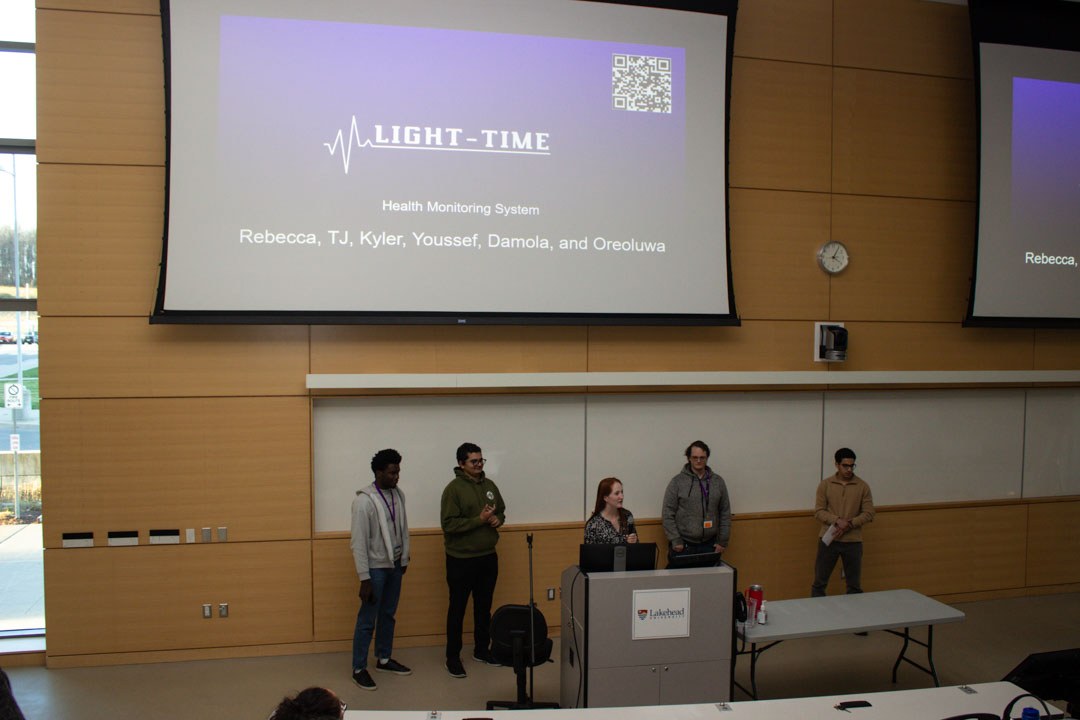
Presenting LIGHT-TIME at the Orillia event on 15 November.
The problem
Medical care in space is delivered by the crew. On the International Space Station, a crew medical officer, a crew member who does not have to be a physician (NASA-STD-3001), carries out tests and treatment on board. A flight surgeon, a physician in mission control, advises them in near real time. Former crew medical officers describe the role as a healthcare extender to the flight surgeons on the ground (LaBarbera et al., 2023).
That arrangement depends on a fast link. On 14 November 2026, NASA JPL Horizons put Mars 198.1 million km from Earth: 660.86 seconds one way, so a question and its answer take 1,321.72 seconds, about 22 minutes. Over the years the one-way delay ranges from about 3 to 22 minutes, and around solar conjunction, when the Sun sits between the two planets, there is no link at all.
We took the challenge "Create Health Monitoring Software for Astronauts on Space Missions" and narrowed it to one question: when a crew member's blood oxygen starts falling, can Earth respond in time, and if not, who should act?
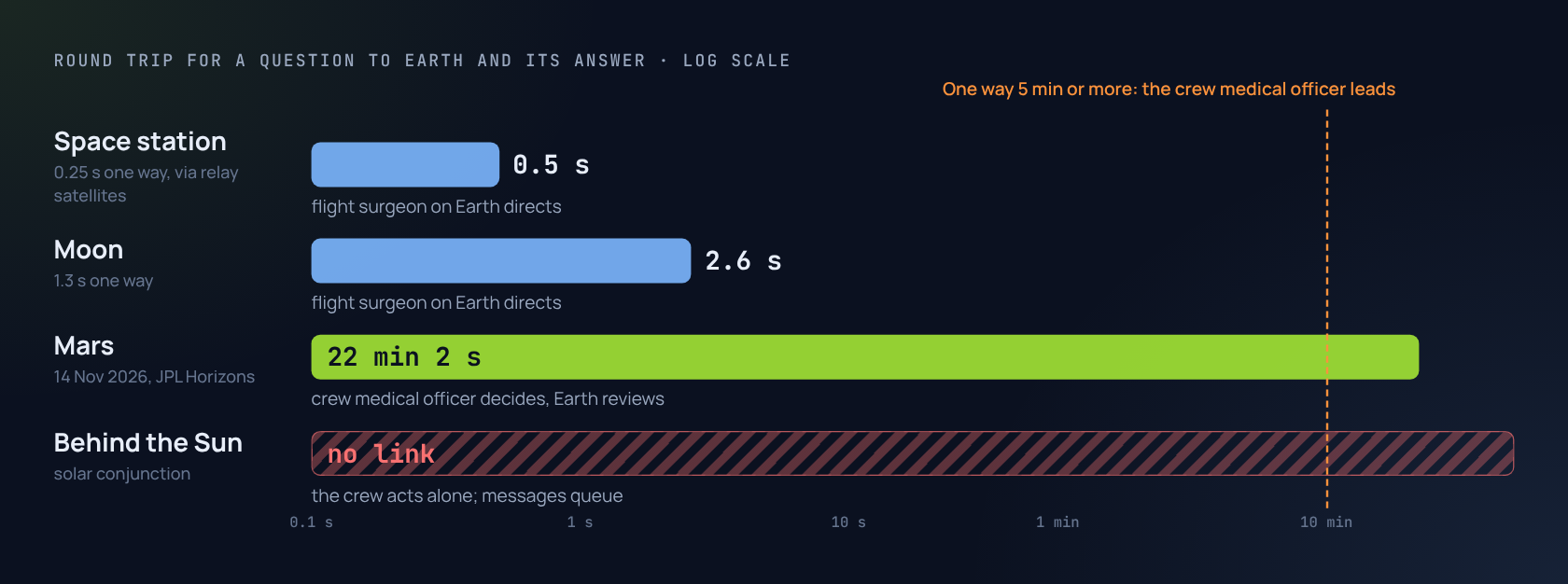
The round trip at each stop on the dial, on a log scale. Right of the dashed line, a one-way delay of five minutes or more, the crew medical officer leads.
Monitoring vital signs is not new. The Canadian Space Agency's Bio-Monitor already records heart rate, blood oxygen, skin temperature and more from one shirt. LIGHT-TIME adds the delay: it uses the round trip to Earth as an input to every alert decision. NASA lists distance from Earth as one of the five hazards of human spaceflight, and its plans for Earth-independent medical operations give the crew more responsibility for care as missions go further out.
What we built
LIGHT-TIME has three parts. The ship, or base station, is the crew's console and the computer behind it. It shows four crew members, each scored against their own pre-flight baseline, and the cabin: carbon dioxide, oxygen, pressure, temperature, radiation and space weather.
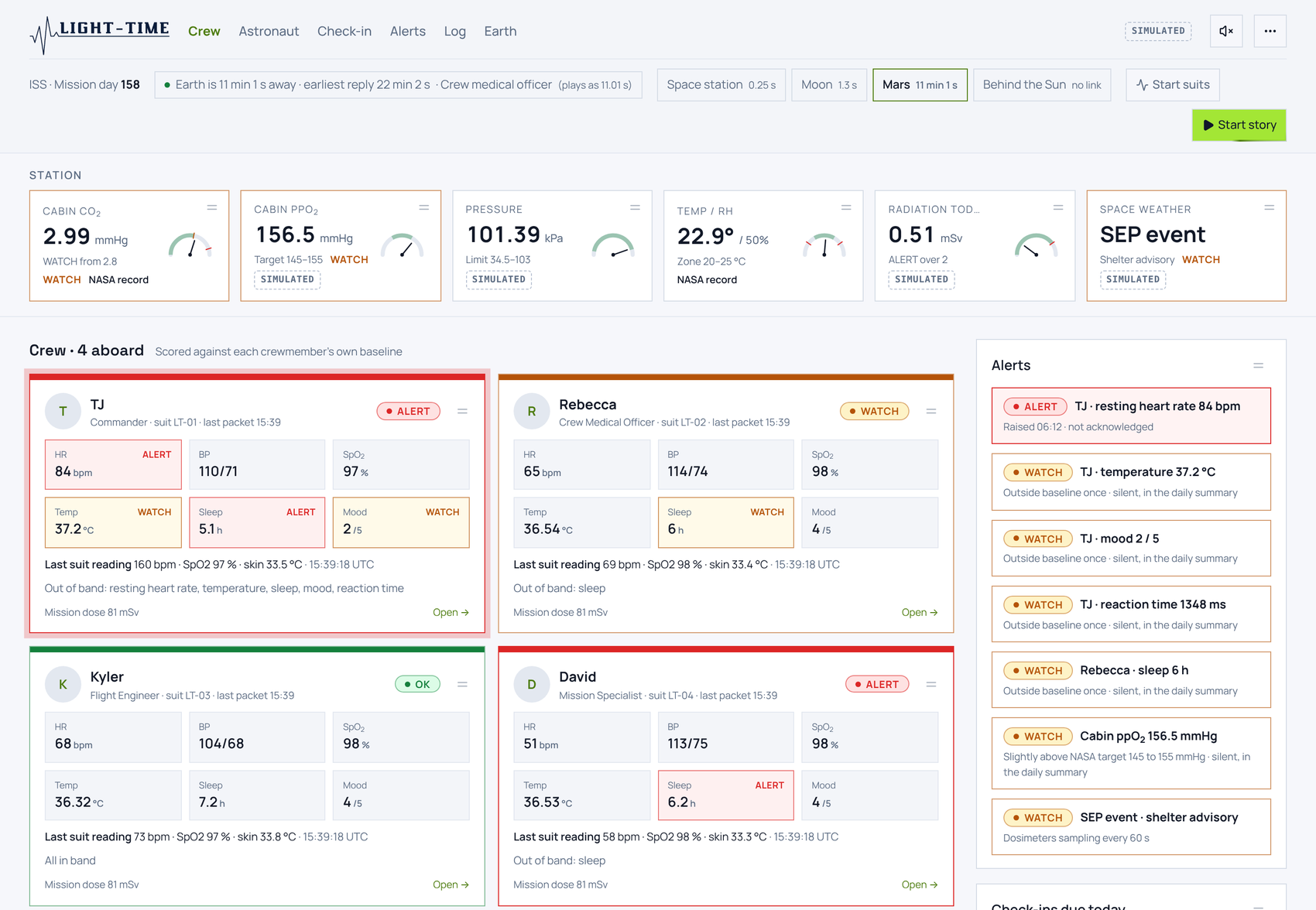
The crew console. Crew readings are simulated and labelled; the cabin carbon dioxide, temperature and humidity replay a NASA record from the space station.
Earth, or the command center, is the flight surgeon's console. It shows only what has crossed the link, as old as the light time, and any reply takes the same time to come back.
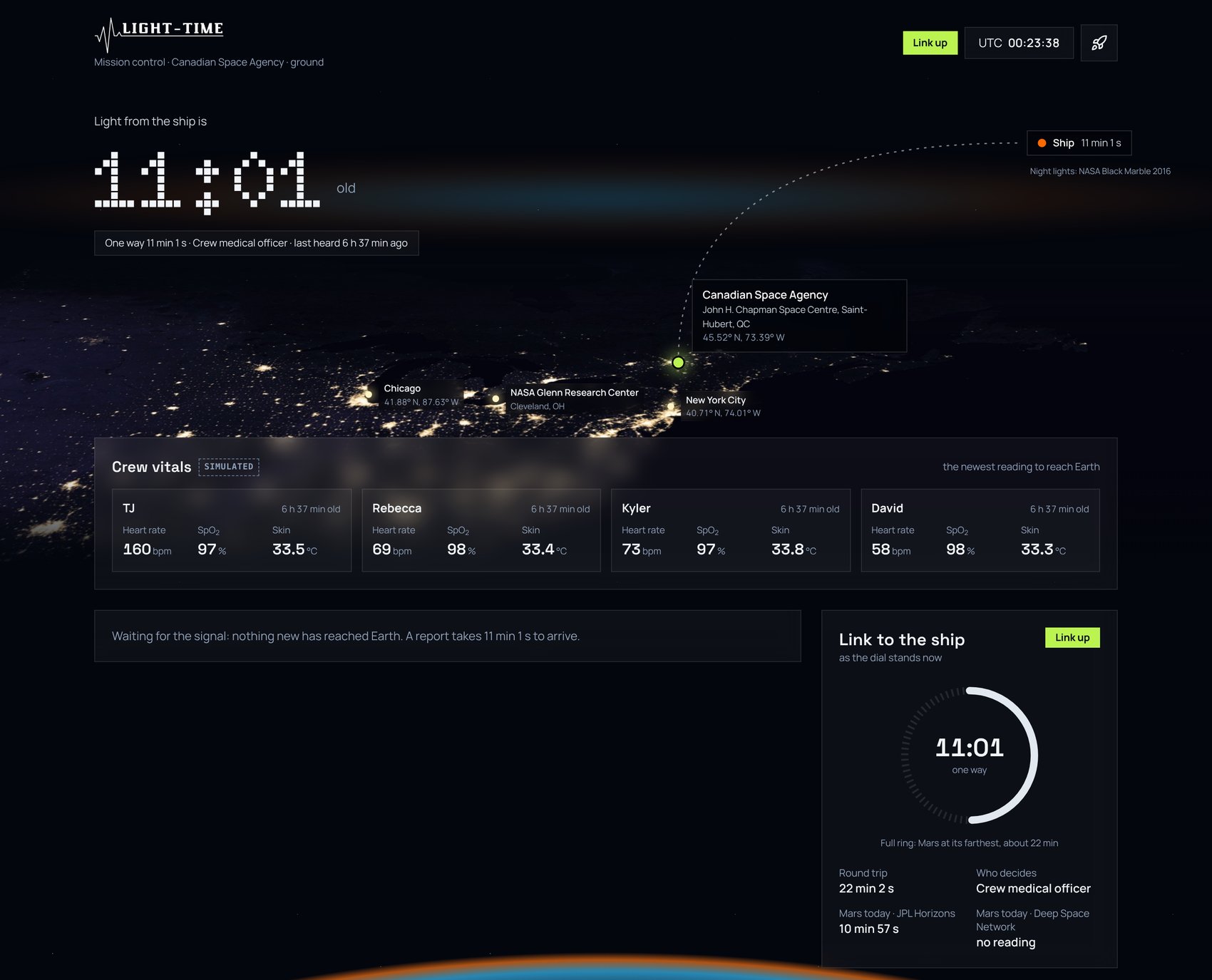
The Earth console. Night lights from NASA Black Marble.
The link between them is a table of messages, each stamped with when it was sent, the delay and when it lands. A dial in the ship's header has four stops: the space station (0.25 seconds one way, through relay satellites), the Moon (1.3 seconds), Mars (11 minutes 1 second on our date) and behind the Sun (no link). Moving the dial changes the delay, who decides and what the ship says, on every screen at once.
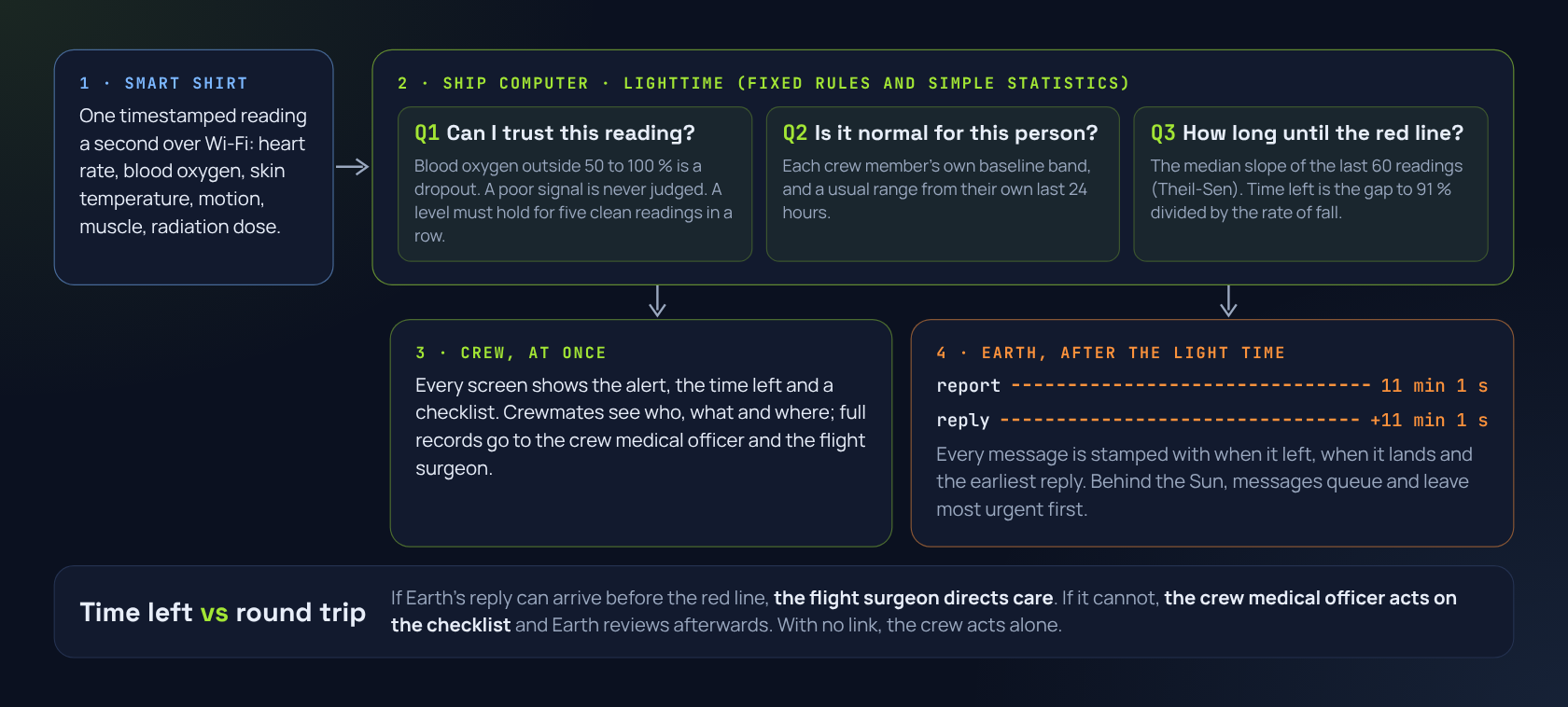
One reading a second goes from the shirt to the ship. The ship alerts the crew at once, and Earth receives the report a light time later.
We assume each crew member wears a smart shirt like the Bio-Monitor for the whole mission, an assumption our mentor asked us to state. Youssef Ali, the team's hardware engineer, designed the sensors we would add to that shirt and documented them in our hardware write-up. An ESP32 microcontroller in a removable module at the waist reads heart rate and blood oxygen, skin temperature, motion, muscle activity and radiation dose, plus a blood-pressure cuff used at scheduled check-ins, and sends timestamped readings to the ship over Wi-Fi.
The shirt has not been built. During the hackathon a hobby pulse-oximeter board stood in for it, and the demo's readings are simulated. No rule yet uses the motion or muscle readings.
How the triage works

The four stages, with a worked example for Mars.
The ship's adviser, LIGHTTIME, runs every reading through four stages, once a second, for each crew member. It uses fixed rules and simple statistics. No trained model makes or changes a decision.
1. Validate the reading
Many false alarms on a patient monitor come from the sensor, not the patient, so the first checks are on the signal. A blood-oxygen value outside 50 to 100 % is treated as a dropout, not a measurement. A reading flagged with a poor signal is never judged; the ship asks for a sensor check instead. After any poor reading, nothing can raise an alarm for the next 10 readings, because a sensor that has just been put back on reads low for a few seconds.
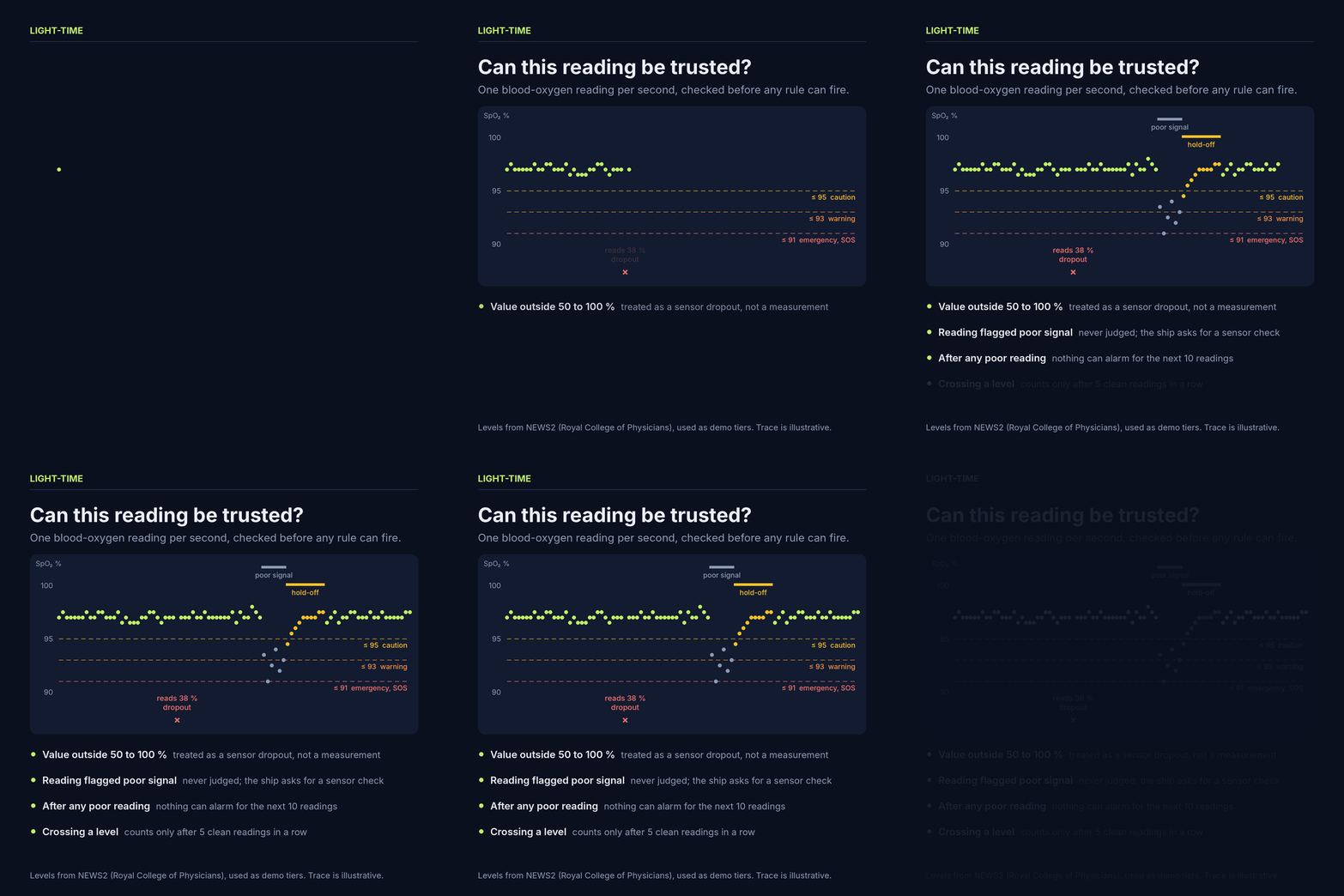
An illustrative trace. A dropout and a run of poor-signal readings pass through without raising an alarm.
2. Classify severity
The severity levels come from NEWS2, the early-warning chart of the Royal College of Physicians: 95 % or less is a caution, 93 % or less a warning, and 91 % or less an emergency, which raises an SOS and sends the report to Earth automatically. A level only counts once it holds for five clean readings in a row. NEWS2 is a hospital score and has not been tested in spaceflight, so these are demo tiers with a named source, not flight rules.
Each crew member also has a usual range, the 1st to the 99th percentile of their own clean readings over the last 24 hours. It gives context on the crew card and in every report but never raises an alarm, because on real wrist recordings a personal range was too wide to alarm on.
3. Estimate the time left
A fixed threshold only fires once the reading is already low. The third stage estimates when that will happen. The ship fits a Theil-Sen line to the last 60 clean readings: the median of the slopes between every pair of readings, 1,770 slopes in all. A median of slopes is much less sensitive to a few bad readings than a least-squares line; up to about 29 % of the points can be wrong before the estimate fails. The ship raises an early caution only if the fall is consistent (Kendall's rank correlation of at least 0.5 between time and the reading), it drops at least 2 points across the window, and the red line is no more than 10 minutes away.
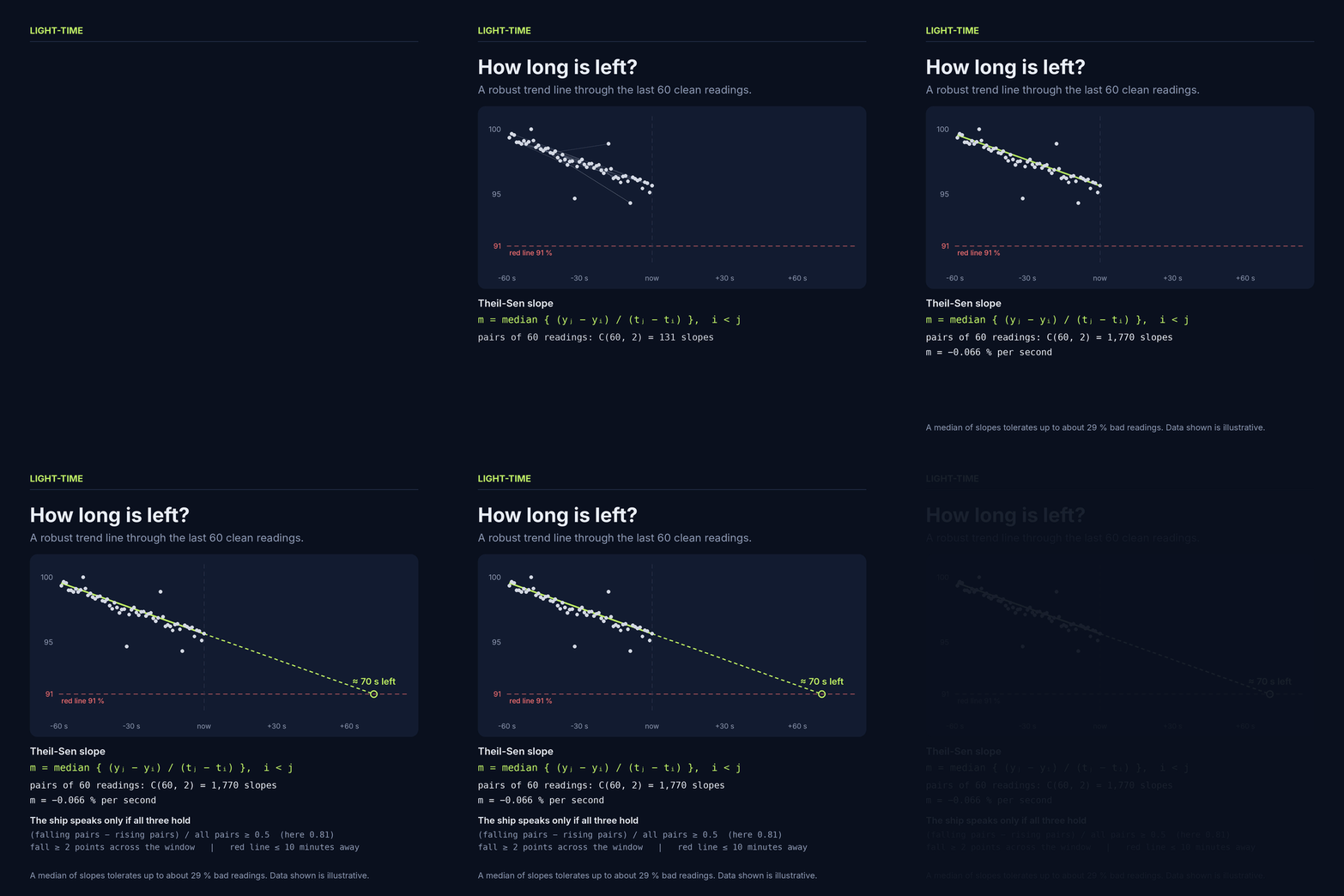
Illustrative data. The agreement shown, falling pairs minus rising pairs over all pairs, is the size of Kendall's rank correlation between time and the reading.
time_left  = (median of the last 5 readings - 91) / rate of fall
reply_time = 2 x one-way light time
Earth can answer in time only if reply_time < time_left
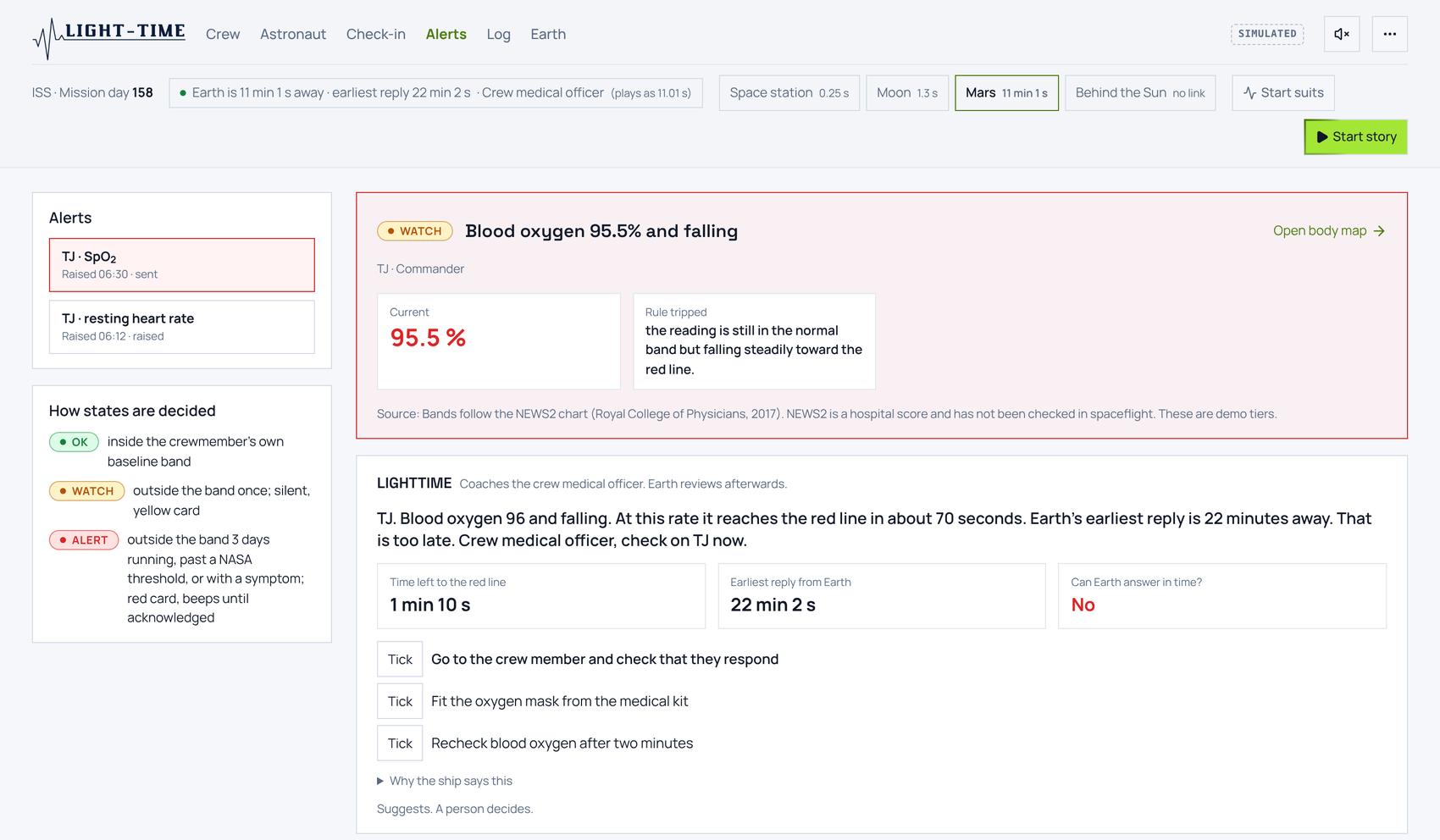
The early caution, raised while the reading was still in the normal band. The sentence is built from fixed templates and read aloud by the browser's speech synthesis.
The ship stores this comparison in the report, so Earth later sees what the ship knew when it raised the alert. Every alert lists its reasons under "Why the ship says this" and ends with the same line: "This is a fixed rule, not a diagnosis. A person, not the ship, decides."
4. Route by light time
One rule decides who leads, with three cases. Under 300 seconds one way, the flight surgeon directs care, as on the station today. At 300 seconds or more, the crew medical officer leads and Earth reviews afterwards. With no link, the crew acts alone, and every message waits in a queue that is sent most urgent first when the link returns.
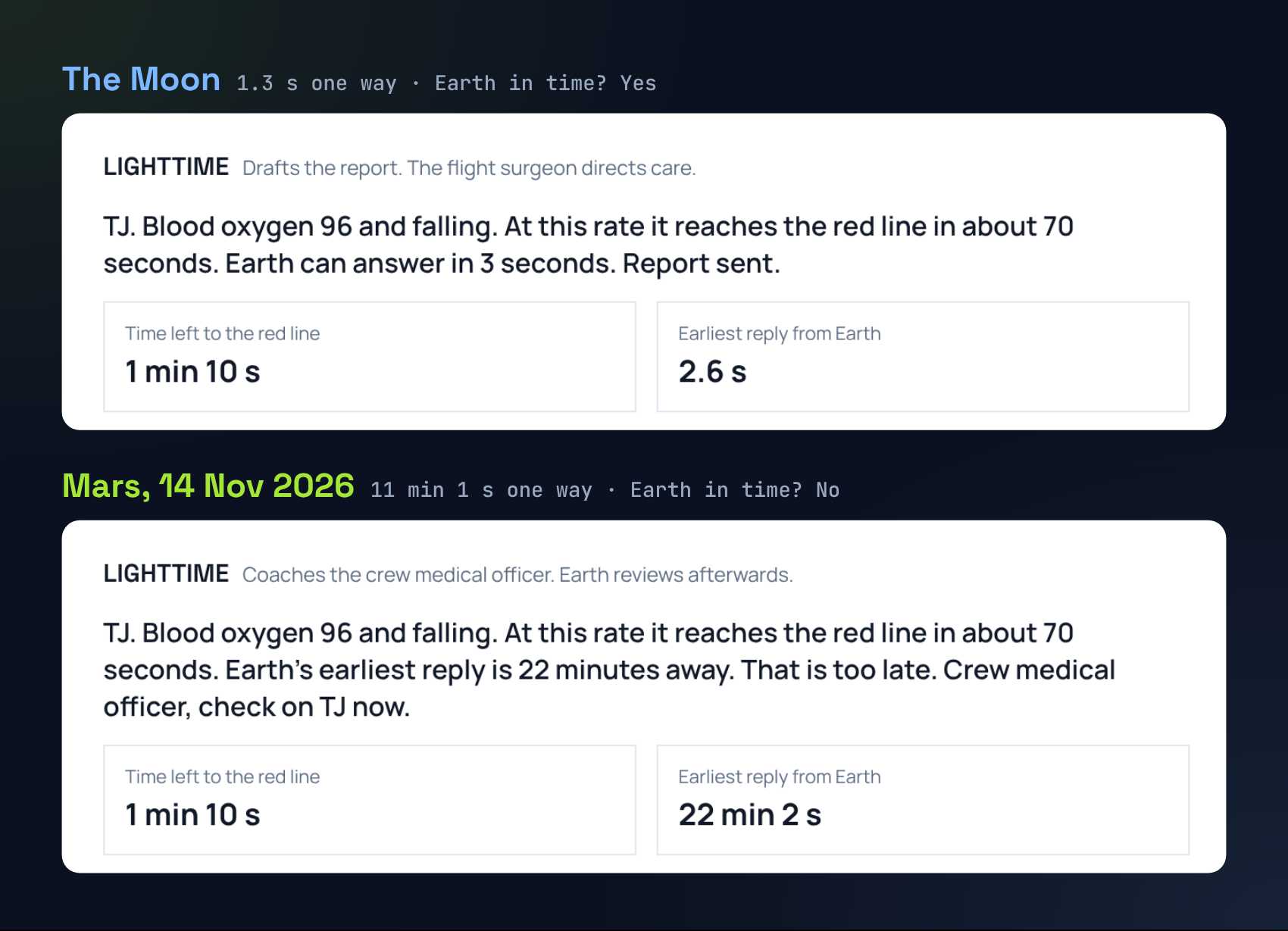
The same simulated reading with the dial at the Moon and at Mars. Nothing else was changed.
The 300-second switch is a design choice. It is based on NASA's NEEMO 16 analog mission, which ran a simulated medical emergency at a five-minute delay and concluded that more crew medical autonomy is desirable at delays of five minutes or more (Rader et al., 2013). That is one simulation with one crew, so 300 seconds is a reasoned setting, not a measured threshold. It is a single constant in the code.
The delayed link
Every message between ship and Earth is a row with three times: sent, delay and lands. Earth's API reads only that table, and an automated test fails if Earth's code ever imports the ship's crew, reading or alert tables, so the Earth console cannot show anything Earth would not have received yet.
The Mars delay is live: the ship asks NASA JPL Horizons for the light time on the mission date, and the Earth console checks it against the round-trip light time NASA's Deep Space Network reports for spacecraft at Mars. At 21:49 UTC on 15 November the two were 1.6 seconds apart. For the stage demo, any leg of a minute or more plays 60 times faster, with the true figure kept on screen.
Results
There is no open astronaut data, so before a rule was allowed to raise an alarm, we ran public recordings from healthy volunteers through the ship's own code. Six adults breathed low-oxygen gas in a lab while a finger oximeter recorded once a second (Hoffman et al., 2022).
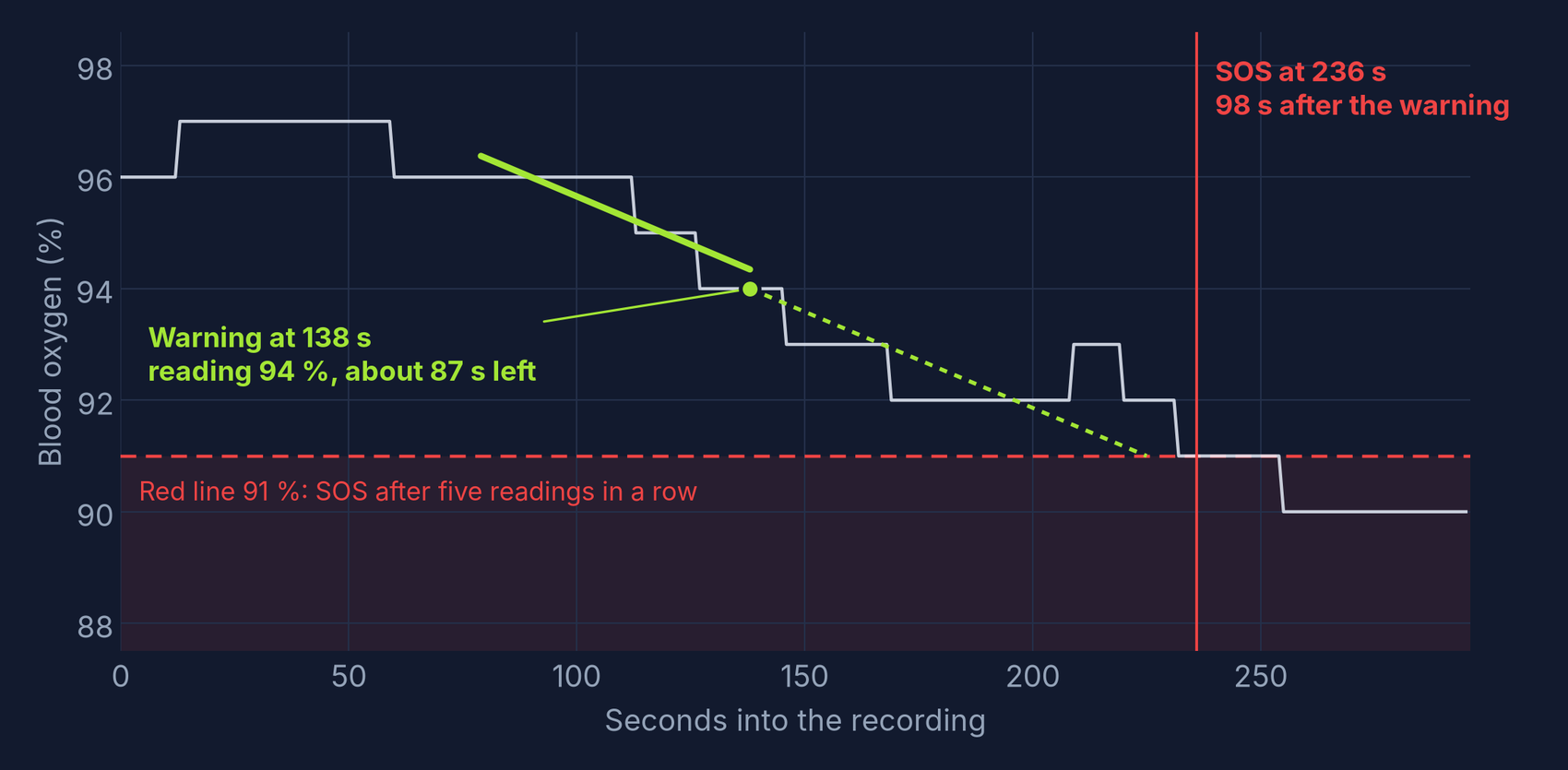
Volunteer 100003. The thick line is the ship's trend through the 60 readings before the warning, and the dotted line is where it leads.
| Volunteer | Warning at | SOS at | Warned ahead by | Time left the ship stated |
|---|---|---|---|---|
| 100001 | 162 s | 321 s | 159 s | 142 s |
| 100002 | 235 s | 341 s | 106 s | 56 s |
| 100003 | 138 s | 236 s | 98 s | 87 s |
| 100004 | 221 s | 317 s | 96 s | 58 s |
| 100005 | 112 s | 180 s | 68 s | 84 s |
| 100006 | 114 s | 128 s | 14 s | 26 s |
The ship warned before the SOS in all six recordings, by a median of 97 seconds (range 14 to 159). The time left it stated at the warning was within 50 seconds of what happened in every case. The trend settings (window, minimum fall and agreement) were chosen by leaving each volunteer out in turn: 18 combinations, tuned on five people and tested on the sixth. All six rounds picked the same settings. Six recordings is a small sample, so this checks that the rule behaves as designed; it is not a validation.
On a 7.8-hour night from a person who was well (Apnea-ECG record c01r; Penzel et al., 2000), the trust rules reduced false SOS alarms from four with every number believed, to one with impossible values rejected, to zero once the sensor had to settle after a dropout. The time-left rule still raised two cautions that night. A caution does not send an SOS, but both were false warnings.
Two results were negative. Hospital heart-rate bands, applied to wrist recordings of 15 healthy volunteers (PPG-DaLiA; Reiss et al., 2019), flagged 14 of the 15 while they sat at a desk, so heart rate is shown and sent to Earth but does not raise an alarm by itself. On a night of sleep apnoea, where oxygen falls fast and often, the trend warning came first in only 32 % of falls. For falls that fast, the fixed thresholds do the work.
Feedback from the Canadian Space Agency
One of the highlights of the event was working with Anastasiia, our Canadian Space Agency mentor. She told us that monitoring on the station today is mostly periodic: scheduled checks that the crew medical officer logs and sends to the ground. Astronauts accept those checks, but they do not want to be monitored around the clock. She asked for two things from any onboard software: recommendations a crew member can trace and override, and health data kept off the public internet. She also pointed out that not every crew member should see every record.
Her advice changed the build. No decision calls a language model or an outside service, and every alert names the reading and the rule that raised it. The ship's API shapes each answer by role: full records go to the crew medical officer and the flight surgeon, every other crew member sees their own record and a name card for the rest, and an SOS reaches everyone with only who, what and where. These are role-based views, not a login. Nothing in the demo yet verifies who is at the screen.
My role and how I used AI tools
I built the Flask ship computer, the alert rules and the scripts that test them on the recordings, the delayed link, the Horizons and Deep Space Network checks, the role-based views and the demo's scripted story, and hardened the service for hosting. I also wrote the backend documentation, the concept document and the research paper, which list all six of us as authors.
I used Claude and Claude Code throughout the weekend, and every use is logged with its date and purpose in the backend's AI_USE.md. Claude helped me write a design spec and a task-by-task plan. Claude Code built the plan test-first, one task at a time. Separate review agents then checked the work, and every finding was reproduced before anything was fixed. The backend finished the weekend with 271 passing tests.
The tools did not decide what the software should do. The alert levels come from a published chart, the trend settings were chosen on real recordings, and two rules were switched off because the data showed they would raise false alarms. No AI model runs inside LIGHT-TIME.
The team
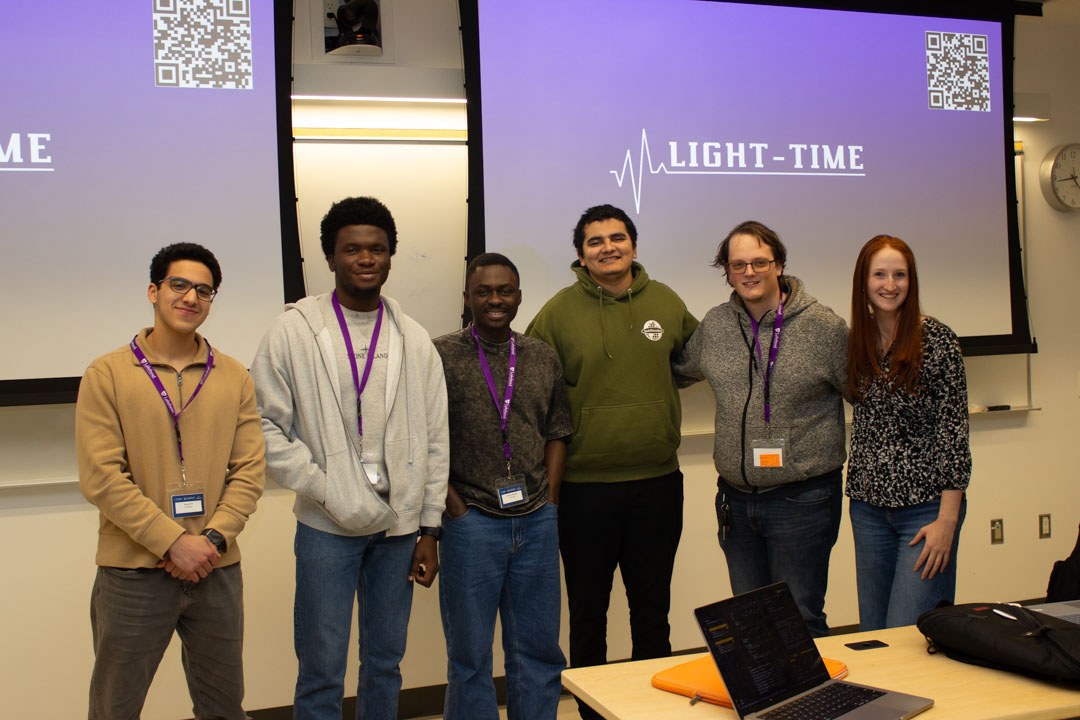
The team after the pitch. Photo: NASA Space Apps Challenge Orillia.
The six of us are Oreoluwa Akinnukawe, Youssef Ali, Tirthesh Jani, Rebecca Mazzocco, Damola Olutoke and Kyler Visser. Rebecca led the team and kept our documentation together. Youssef designed the suit hardware. Kyler and Oreoluwa worked on the backend, hosting and data with me: Kyler built the Docker image for Google Cloud Run, and Oreoluwa built the generated mission month, the Earth console's case routes and the vitals feed. Damola built the crew and Earth consoles in Next.js.
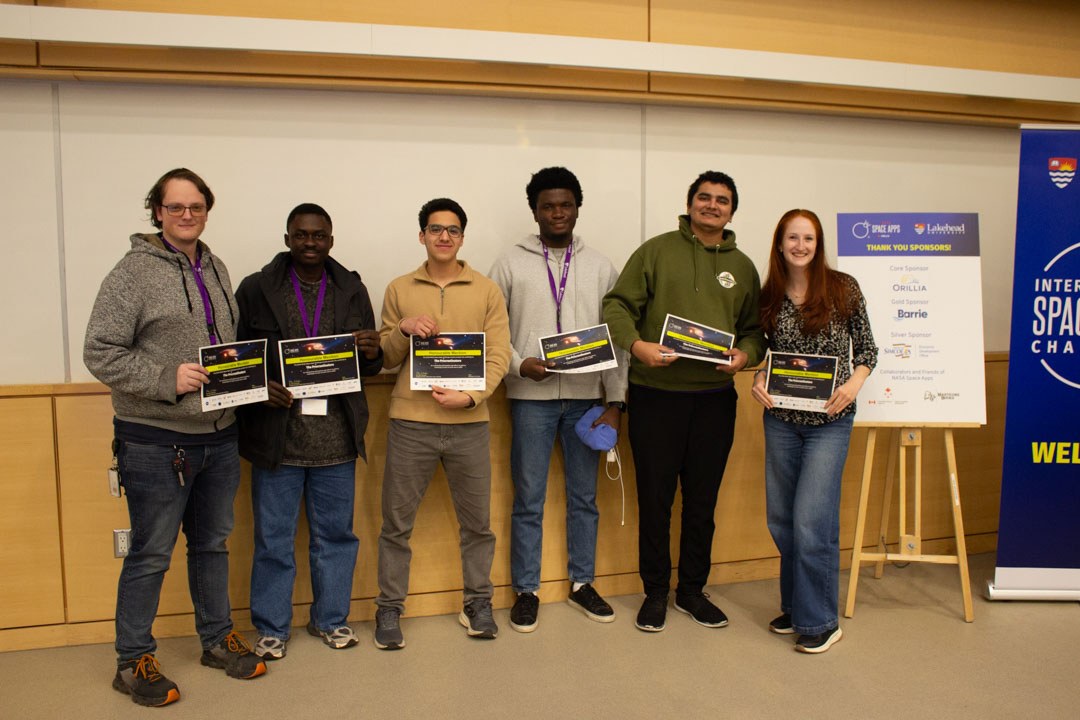
Our Honourable Mention from the Orillia event.
Limits and next steps
The evidence is six laboratory events and two nights from healthy volunteers on Earth. It shows that the parts work as designed, not that the system would help a crew, and the settings and the test share the same recordings. The severity levels come from a hospital chart that has not been tested in spaceflight, and the 300-second switch is a design choice. The light time leaves out relay and ground processing. At the start of a fast fall, the 60-reading window still holds flat readings, so the stated time left runs long: in the scripted story the ship says about 70 seconds and the SOS comes 13 seconds later. There is no rule yet for a fast heart rate at rest or a stuck sensor. LIGHT-TIME is not a medical device.
Next, we would build the shirt and test it in an analog habitat on Earth with the delay imposed, using real sensors and a busy crew. We would add a sign-in for each role and an emergency unlock that lets the crew member helping a casualty open that person's record, logged and reviewed afterwards. We would also test the time-left rule on more recordings and ask a flight surgeon to review the severity levels.
Sources
- Live demo: lighttime.health
- The math and the evidence in full: How LIGHT-TIME works
- NASA. NASA-STD-3001 Volume 1, Section 5.0: Training (crew medical officer training)
- LaBarbera MA et al. (2023). Assessing Crew Medical Officer Preparedness for International Space Station Missions. NTRS 20230013415
- Giorgini JD and the JPL Solar System Dynamics Group. NASA/JPL Horizons
- NASA Jet Propulsion Laboratory. Deep Space Network Now
- Hoffman JS et al. (2022). Smartphone camera oximetry in an induced hypoxemia study. npj Digital Medicine 5: 146. doi:10.1038/s41746-022-00665-y
- Penzel T et al. (2000). The Apnea-ECG Database. Computers in Cardiology 27: 255 to 258. doi:10.13026/C23W2R
- Reiss A et al. (2019). Deep PPG: large-scale heart rate estimation with convolutional neural networks. Sensors 19(14): 3079. doi:10.3390/s19143079
- Royal College of Physicians (2017). National Early Warning Score (NEWS) 2
- Rader SN et al. (2013). Human-in-the-Loop Operations over Time Delay: NASA Analog Missions Lessons Learned. NTRS 20130011552
- NASA Human Research Program. Hazard: Distance From Earth
- Canadian Space Agency. Bio-Monitor